
Seeds of Hope: Echapu’s Search to Nourish Uganda

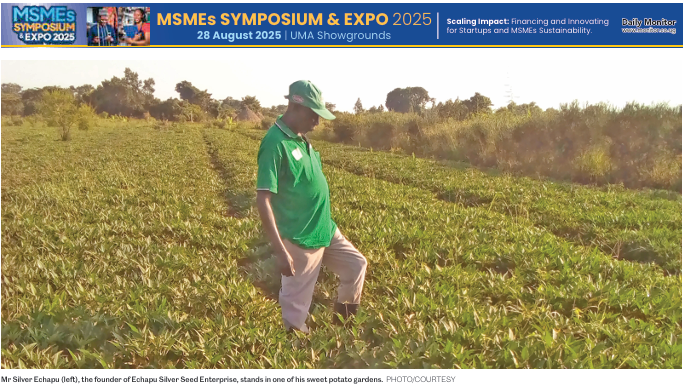
In Uganda’s Teso sub-region, sweet potato vines stretch across the land in lush green carpets. Yet for years, their true potential remained largely overlooked. For Mr Silver Echapu, however, this abundance represented an opportunity waiting to be unlocked.
Through repeated farmer trainings, one lesson stood out clearly: access to quality seeds at the right time can dramatically transform harvests.
“In most of the workshops I attend, they stress that farmers need seed availability at the right time to get a good output,” he recalls.
Motivated by this insight, Echapu ventured into seed farming, growing and distributing improved, vegetatively propagated sweet potato vines to help farmers plant on time and achieve better yields.
Planting the First Seed
The journey began in 2004, when Echapu identified a gap in the supply of vegetatively propagated seeds, particularly sweet potato vines, in regions that needed them most.
With Shs1.8 million, he launched Echapu Silver Seed Enterprise, borrowing Shs1 million and topping it up with Shs800,000 from his personal savings.
Accessing finance was far from easy.
“Getting a loan from the bank wasn’t easy. The paperwork was overwhelming, and when repayment time came before I had earned anything, the pressure was intense,” he recalls.
Products Beyond Seeds
Echapu specialises in propagated crops, including improved varieties of sweet potatoes such as Orange-Fleshed Sweet Potatoes, known for their nutritional value.
But his work goes beyond selling seeds. He conducts training sessions on planting techniques, weed management, and understanding crop maturity periods.
By combining seeds with skills, he ensures farmers are better equipped to maximise their harvests.
Reaching Communities That Need It Most
Echapu supplies high-quality planting material to local communities, NGOs, and agricultural projects across Uganda. His work supports resettlement programmes in northern Uganda and nutrition-challenged regions such as Karamoja.
“There are nutrition needs in some parts of Uganda, especially in the northern and northeastern regions,” he says.
Through this approach, he empowers farmers, strengthens livelihoods, and contributes to local economic growth.
Financial and Market Pressures
Starting and sustaining the business has not been without financial strain. High interest rates, particularly from village SACCOs, have been a major challenge.
“If they charge 10 percent per month, that is a very high interest rate,” Echapu notes.
To market his products, he relies on community outreach and radio advertising, which also come at a cost. Still, satisfied farmers often become his strongest promoters, recommending his seeds to others.
Ensuring Seed Quality
To maintain quality, Echapu sources seed material from laboratories such as Senai Laboratories, where a bag costs about Shs40,000. During scarcity, he imports from Kenya at roughly Shs80,000 per bag, a move he makes once every three years.
Transport and labour further increase operational costs, with truck hire ranging from Shs1.6 million to Shs1.8 million per trip.
Learning, Training, and Growth
Continuous learning has been central to Echapu’s progress. Trainings have equipped him with techniques for producing large quantities of vegetative seeds.
“I learned how to space crops to get more seeds, together with close weed management,” he says.
He now passes this knowledge on, training fellow farmers and out-growers while remaining optimistic about future capacity-building opportunities through SME federations.
Weather, Water, and Uncertainty
Recent changes in NGO funding—particularly the halting of support from USAID, once his biggest client—have affected revenues. This has pushed him to rely more on imported seeds, increasing costs and reducing margins.
Water scarcity during dry seasons also poses a major challenge.
“Dry seasons are the most profitable, but water becomes a big problem if you haven’t identified a reliable spring,” he explains.
Moments That Made It Worthwhile
Despite the hurdles, Echapu’s journey has had its rewards. One of his proudest moments came in 2022, when a successful sales season enabled him to construct and complete a permanent home for his family.
Looking Ahead
As Uganda’s MSMEs continue to seek sustainability and growth, stories like Echapu’s highlight the importance of coordinated support, access to finance, and knowledge sharing.
Platforms such as the MSME Symposium & Expo 2025 aim to bring together key players to unlock solutions that will help entrepreneurs scale beyond survival and build lasting impact.
Responses